


Great Reasons to Buy an Offshore Yacht with Partners – And How to Do it Right
December 14, 2019 | Diane KohlhaasGreat Reasons to Buy an Offshore Yacht with Partners – And How to Do it Right
Buying a yacht is often the culmination of a dream.
You dream of quiet nights at anchor in remote, exotic locations…glittering nightlife at exotic resorts and marinas…five-star entertainment for your business guests…even weeks or months “off the grid,” pursuing your passion for fishing, diving, kayaking, or just hanging out on deck.
And once the dream becomes a reality, life happens.
You start your yachting life excited, getting out on water every chance you get. And then life gets in the way. The job gets in the way. You don’t have as much free time as often as you thought you’d have. Instead of weeks aboard, you try to steal away for the occasional weekend. And those weekends become less and less frequent.
Finally, your gleaming dream sits among so many others, unused and unloved, at the marina or in storage.
That’s no way to treat an asset.
If you ever find yourself browsing the classified ads in the Wall Street Journal, you’ll no doubt see lots and lots of ads for partnerships in airplanes, vacation condos, or overseas apartments – all of them placed there by folks just like you who bought a dream and find they’re just not using it as often as they’d like.
Everyone knows that assets benefit from regular use. Condos, apartments, and homes benefit from airing out. Machinery runs better when it’s used regularly. Wouldn’t a yacht benefit more from use than it would sitting at the dock?
So why not buy your next Offshore Yacht with a partner?
We can think of several advantages for buying an Offshore Yacht in partnership with others.
Benefits of Owning Your Offshore Yacht with Partners
- Reduce your initial investment costs. It can be intimidating to take on the total initial purchase price of a new yacht alone. Buying a yacht in partnership with one or more people will reduce the initial investment to a fraction of the total.
- Reduced monthly and annual expenses. The partnership will share the fixed monthly and annual expenses like moorage and insurance, reducing the monthly expenses for each individual.
- Shared maintenance costs. Your new Offshore Yacht will need regular maintenance. Regular and routine washing, polishing, waxing, oil and fluid changes, systems checks, bottom cleaning, running gear maintenance, and haulouts are all a part of yacht ownership, and sharing ownership means sharing the burden and cost of maintenance.
- Special tax benefits. If you and your partners structure your agreement correctly, you and your partners can take advantage of certain tax benefits of owning a yacht, particularly if you use your Offshore Yacht in your business activities. You’ll want to discuss these advantages with your attorney and accountant.
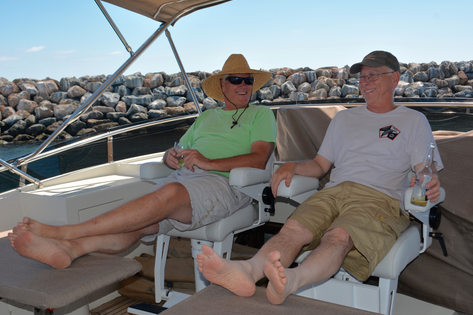
- Shared experience. If you base your yacht partnership on shared interests like fishing, SCUBA diving, kayaking, or kite boarding, you and your partners can all experience the joy of those interests by sharing ownership of the Offshore and participating together.
How to Structure your Yacht Partnership Right
Before any money changes hands, you and your partners must agree (in writing) about how to structure the partnership so that everything from maintenance to scheduling, buying in to selling out, is crystal clear to everyone.
That’s why we recommend that you engage a lawyer familiar with the yachting or marine industry to help you structure your agreement.
When you and your partners are ready to sit down with your lawyer, make sure that you address, at minimum, the following questions.
What co-ownership structure will work best? Should you work from a simple partnership, joint ownership, LLC, or corporation? In our experience, an LLC (Limited Liability Corporation) is often a viable structure for most partnerships. It’s a hybrid between a partnership and a corporation, and offers flexibility, limited liability, and tax advantages to the partners while being fairly simple and inexpensive to administer.
What is and is not included in the partnership? Your agreement should list absolutely every item on the yacht included in the partnership, including manufacturer, model, size, and serial numbers of every piece of equipment from the engines to electronics to entertainment systems. Also list everything that is not included, such as personal equipment or gear.
How will you document and pay expenses? All regular, fixed expenses including moorage, insurance, scheduled maintenance, taxes, and licensing should be detailed, spelling out procedures for collection and payment from each partner. All ongoing operating expenses like fuel, oil, fluid changes, repairs, routine haulouts, bottom cleaning, as well as “household” expenses like water, electricity, or internet, need to be detailed, with policies and procedures spelled out clearly. Will you use a certified marine mechanic, commercial diver, or professional electrician for maintenance and repairs, or will each partner do their own work? As long as the partners spell out their policies and procedures clearly in advance, nobody will be surprised or caught short.
How will you and your partners schedule time on your Offshore Yacht? Who gets to use the yacht, and when? Will you divide the year up into two-, three-, or four-week blocks and allow each partner to choose first and second-choice time periods? We encourage you and your partners to embrace communication, flexibility, and cooperation as you work together so everyone gets a fair share of time aboard. You can take advantage of online scheduling solutions or yacht management services to help you work out your schedule for a fee.
What are the operational limits of the yacht? Your marine insurance policy will have a large impact on the cruising limitations and how far each partner can take your Offshore away from its home port. Who else can operate the boat or take it out? Can partners lend their time to relatives or friends? What qualifications does the boat operator need to have? Is there a required minimum number of crew? Spell everything out in advance, so everyone is clear.
What operational responsibilities must each partner accept? It may seem obvious, but your partnership agreement must specify that anyone operating your Offshore Yacht must follow the Coast Guard’s official Rules of the Road, as well as the COLREGs (International Regulations for Preventing Collisions at Sea), all federal, state, and local laws, the insurance contract, and all operating limitations of the boat and equipment.
What special policies and procedures must each partner follow? You and your partners should spell out, in detail, things like pet policy, smoking policy, and breakage/repair/replacement policy. Spell out your partnership’s recordkeeping/logbook requirements, as well as your “turnover” procedures – the standards of cleanliness and repair that each partner should maintain when they return the Offshore to the slip.
Who is going to be the partnership’s official recordkeeper? Determine who will maintain the business and accounting records of your partnership, and how they will assure the safekeeping of registrations, certificates, and other documentation.
What’s your exit strategy? When it’s time for you or one of your partners to sell his or her share in your Offshore, do the other partners automatically get first right of refusal? Do the remaining partners need to interview or approve of any new partner? When a partner must walk away for health reasons, loss of income, or even death, what happens? Spell everything out so you don’t leave anyone “holding the bag.”
As you can see, there is a dizzying amount of information to consider as you look at the possibility of buying your Offshore Yacht with partners. But you don’t have to contend with it all by yourself.
At Offshore West, we take pride in working with our Offshore owners and helping them through every step of the purchase, commissioning, and eventual sale of their Offshore Yachts. And we are more than happy to point you toward professionals who can help you and your partners structure the right kind of agreement for your needs.
We think that buying an Offshore Yacht in partnership with like-minded boaters who share your interests might be one of the best ways to enjoy this remarkable yacht, and we’d be delighted to help.
Call our Newport Beach or Fort Lauderdale office to chat and explore the possibilities.
